It's always best to be offended by things you haven't read. That way you keep your mind uncluttered by things that might change it.
Friday, October 27, 2006
Quote of the Week
This one will be on my sidebar, eventually. It's from Sci-Fi/Fantasy author Neil Gaiman, one of my favorites, from his blog "Neil Gaiman's Journal."


Tuesday, October 24, 2006
Say No To Prohibition
On the Colorado General Election Ballot:
One of the most difficult issues to address in today's society is the argument against prohibition. It is, perhaps, the hottest of the political hot potatoes, and the most difficult to present, because people immediately think this guy --or gal--must be high! One need only look back a few years to see this general reaction when former New Mexico Governor Gary Johnson, a Libertarian who ran and got elected as a Republican, merely suggested that a dialog on repealing prohibition be opened. He was strongly criticized by Republicans, and become the butt of jokes and personal attacks by both branches of the Demopublican Party. A person who uses the word "decriminalize," or "legalize," and the word "marijuana" in the same sentence is accused of being a radical liberal, unless that person's name isWilliam F. Buckley, Jr.
I submit that most arguments either for or against prohibition seem to be written by people who seem to be not on marijuana, but on crack or LSD. The argument that marijuana "leads to the use of more dangerous drugs," is absurd and has no scientific substance. The argument that marijuana is "as safe as alcohol" is equally absurd, because unmoderated alcohol abuse is highly dangerous.
It is also necessary, when making arguments against prohibition, to declare "I am not under the influence of, nor do I condone the use of marijuana for recreational purposes."
There is a serious cost of prohibition, both in financial and in human terms. Prohibition creates an underground economy, run by criminal elements and corrupt officials, and makes it difficult to regulate who buys the product and from whom it is bought. As Buckley points out, it is easier for an underage person to buy marijuana than it is to buy beer or alcohol products, because beer and alcohol are regulated, and marijuana isn't.
It can't be proven that marijuana leads to harder drugs. If that were true, nearly everyone I know would be a heroin, cocaine, or metha-amphetemine addict. Rather, I submit, that it is the prohibition of marijuana which has led to the abuse of aerosols, amphyl- and butyl- nitrates, prescription drugs, and to the rise of "bathtub" metha-amphetemines. Because of marijuana prohibition and the enforcement thereof, in many parts of the country, these substances are more readily available than marijuana.
Many of us have seen those advertisements which link marijuana use to terrorism and subversive elements. Again, this can be blamed on marijuana prohibition, as much of that product is smuggled into the country, and the money goes to FARQ in Columbia, to the Shining Path Maoist movement in Peru and Chile, to fanatical Islamist terrorist organizations in the Phillipines, and to organizations in Venezuela and Bolivia which train and support terrorists who find their way inside US borders. Mexican Cartels and corrupt officials in that country profit greatly from marijuana prohibition in the United States. An end to prohibition would give the U.S more control over the distrubution of marijuana money. Legalization of the possession of small amounts of marijuana is only a small step toward what really needs to be done--domestic cultivation of marijuana needs to be legalized in order to prevent the funding of terrorist groups. The opening of legal marijuana trade with such countries as Jamaica and Canada is also something that should be looked at down the road, in order to prevent the money from falling into the wrong hands.
An argument used to support prohibition is illustrated by this little tidbit from the Colorado voters' guide, under the heading "Estimate of Fiscal Impact:"
Prohibition proponants see legalization as a suppression of their ability to create and support excessive bureaucracy. Prohibition also allows governments to confiscate private property without a conviction, and without just compensation. But the cost of enforcement outweighs the benifits of the fines and property auctions. Law enforcement resources are distracted from crimes against Natural Law, and more people are in jail for smoking a joint than there are for committing such crimes as rape, burglary, robbery, or assault. This all costs the taxpayers money which could be used for something else, mainly more efficient law enforcement which would better protect us from violent crimes.
The pro-prohibition element claims that legalization would increase marijuana use. In the referenced essay, Buckley laughs at the notion, and points out that The Netherlands has had legal marijuana for years, yet the percentage of the population that uses marijuana is no greater than the marijuana using percentage of the US population. I agree with Buckley, because the notion of doing something just because it is legal is ridiculous. Alcohol consumption and Cigarette smoking are legal, but not everybody smokes cigarettes or drinks alcohol. Eating pork is legal, but not everybody eats pork. It all comes down to personal responsibility, something that no US government from the time of FDR to present wants to recognize in the general population. Social Darwinism isn't necessarily a good thing, but it is a part of nature. Vices will always be with us, law or no law, and everybody chooses their own vices. Morality can not be legislated. It is time to just say no to marijuana prohibition laws.
Amendment 44
Marijuana Possession
Ballot Title: An ammendment to secton 18-18-406 (1) of the Colorado rvisd statutes making legal the possession of one ounce or less of marihuana for any person twenty-one years of age or older.
One of the most difficult issues to address in today's society is the argument against prohibition. It is, perhaps, the hottest of the political hot potatoes, and the most difficult to present, because people immediately think this guy --or gal--must be high! One need only look back a few years to see this general reaction when former New Mexico Governor Gary Johnson, a Libertarian who ran and got elected as a Republican, merely suggested that a dialog on repealing prohibition be opened. He was strongly criticized by Republicans, and become the butt of jokes and personal attacks by both branches of the Demopublican Party. A person who uses the word "decriminalize," or "legalize," and the word "marijuana" in the same sentence is accused of being a radical liberal, unless that person's name isWilliam F. Buckley, Jr.
I submit that most arguments either for or against prohibition seem to be written by people who seem to be not on marijuana, but on crack or LSD. The argument that marijuana "leads to the use of more dangerous drugs," is absurd and has no scientific substance. The argument that marijuana is "as safe as alcohol" is equally absurd, because unmoderated alcohol abuse is highly dangerous.
It is also necessary, when making arguments against prohibition, to declare "I am not under the influence of, nor do I condone the use of marijuana for recreational purposes."
There is a serious cost of prohibition, both in financial and in human terms. Prohibition creates an underground economy, run by criminal elements and corrupt officials, and makes it difficult to regulate who buys the product and from whom it is bought. As Buckley points out, it is easier for an underage person to buy marijuana than it is to buy beer or alcohol products, because beer and alcohol are regulated, and marijuana isn't.
It can't be proven that marijuana leads to harder drugs. If that were true, nearly everyone I know would be a heroin, cocaine, or metha-amphetemine addict. Rather, I submit, that it is the prohibition of marijuana which has led to the abuse of aerosols, amphyl- and butyl- nitrates, prescription drugs, and to the rise of "bathtub" metha-amphetemines. Because of marijuana prohibition and the enforcement thereof, in many parts of the country, these substances are more readily available than marijuana.
Many of us have seen those advertisements which link marijuana use to terrorism and subversive elements. Again, this can be blamed on marijuana prohibition, as much of that product is smuggled into the country, and the money goes to FARQ in Columbia, to the Shining Path Maoist movement in Peru and Chile, to fanatical Islamist terrorist organizations in the Phillipines, and to organizations in Venezuela and Bolivia which train and support terrorists who find their way inside US borders. Mexican Cartels and corrupt officials in that country profit greatly from marijuana prohibition in the United States. An end to prohibition would give the U.S more control over the distrubution of marijuana money. Legalization of the possession of small amounts of marijuana is only a small step toward what really needs to be done--domestic cultivation of marijuana needs to be legalized in order to prevent the funding of terrorist groups. The opening of legal marijuana trade with such countries as Jamaica and Canada is also something that should be looked at down the road, in order to prevent the money from falling into the wrong hands.
An argument used to support prohibition is illustrated by this little tidbit from the Colorado voters' guide, under the heading "Estimate of Fiscal Impact:"
Ammendment 44 may reduce state and local government revenues because fines would no longer be assessed for adult marijuana possession of one ounce or less.
Prohibition proponants see legalization as a suppression of their ability to create and support excessive bureaucracy. Prohibition also allows governments to confiscate private property without a conviction, and without just compensation. But the cost of enforcement outweighs the benifits of the fines and property auctions. Law enforcement resources are distracted from crimes against Natural Law, and more people are in jail for smoking a joint than there are for committing such crimes as rape, burglary, robbery, or assault. This all costs the taxpayers money which could be used for something else, mainly more efficient law enforcement which would better protect us from violent crimes.
The pro-prohibition element claims that legalization would increase marijuana use. In the referenced essay, Buckley laughs at the notion, and points out that The Netherlands has had legal marijuana for years, yet the percentage of the population that uses marijuana is no greater than the marijuana using percentage of the US population. I agree with Buckley, because the notion of doing something just because it is legal is ridiculous. Alcohol consumption and Cigarette smoking are legal, but not everybody smokes cigarettes or drinks alcohol. Eating pork is legal, but not everybody eats pork. It all comes down to personal responsibility, something that no US government from the time of FDR to present wants to recognize in the general population. Social Darwinism isn't necessarily a good thing, but it is a part of nature. Vices will always be with us, law or no law, and everybody chooses their own vices. Morality can not be legislated. It is time to just say no to marijuana prohibition laws.
Thursday, October 19, 2006
Say "Thank-you"
There is a website "Let's Say Thanks," from which you can send a postcard of thanks to a military person overseas. Our fighting men and women have been going through a tough time, especially this month. Please take time to visit the site. Whether you believe in the mission or not, these people deserve our thanks.
Tuesday, October 17, 2006
Red Letter Day
This morning, Tuesday, October 17, 2006, at 7:35 EDT, the population of the United States reached three hundred million, according to the US Census Bureau. Since this information comes from a bureaucracy, we probably actually hit that mark about 8 years ago, and it likely took millions of tax dollars to fund the studies that made the figure official. Nonetheless, the United States of America is now the third most populated country in the world, behind China and India.
Today is also the eightieth anniversary of the foundation of the Anti-Imperialism Union, being celebrated in a country that came about as the result of Red Chinese imperialism--North Korea To celebrate, the impoverished people of North Korea get to use electricity after 9:00 PM and watch fireworks, which is probably like watching much needed food going up in smoke.
China signed on to the sanctions against North Korea, but made a statement indicating that they would not do much to enforce those sanction. However, the Chinese are building a fence along the border between their country and NK, have been stopping and inspecting trucks, and are now allowing public access to anti-North Korean regime blogs which they have previously blocked. According to US foreign policy experts, this is the Chinese way of enforcing the sanctions, and showing their displeasure with their neighbor and ally, without officially acknowledging that they are complying with the UN Security Council sanctions.
Today is also the eightieth anniversary of the foundation of the Anti-Imperialism Union, being celebrated in a country that came about as the result of Red Chinese imperialism--North Korea To celebrate, the impoverished people of North Korea get to use electricity after 9:00 PM and watch fireworks, which is probably like watching much needed food going up in smoke.
China signed on to the sanctions against North Korea, but made a statement indicating that they would not do much to enforce those sanction. However, the Chinese are building a fence along the border between their country and NK, have been stopping and inspecting trucks, and are now allowing public access to anti-North Korean regime blogs which they have previously blocked. According to US foreign policy experts, this is the Chinese way of enforcing the sanctions, and showing their displeasure with their neighbor and ally, without officially acknowledging that they are complying with the UN Security Council sanctions.
Monday, October 16, 2006
The United Nations Security Council has unaminously approved and adopted the resolution imposing sanctions on North Korea for its activity in testing what is now confirmed to be a nuclear weapon. The sanction, after much negotiation and compromise between the US, France, Great Britain, Russia, China, and Japan. The sanctions include a ban on trade in nuclear and weapons technology, on travel by North Korean government officials, and on trade in luxury items. The resolution also declares that North Korea must cease its nuclear weapons program. Basically, the sanctions are designed to affect the government of North Korea, and not the people of that country.
How this will change North Korea's behavior is uncertain at this time, but in the past we have seen that UN sanctions and resolutions have had little effect on the actions of roque governments such as Kim Jong Il's.
The North Korean government will more than likely ignore the resolution, and continue to test nuclear weapons.
China has objected to the resolution's call to inspect cargo entering and leaving North Korea, but as of the time of this writing, they are reportedly inspecting trucks entering and leaving the country. China has the most sway over the PROK (People's Republic of Korea), being its primary trade partner. South Korea has also kept trade open with its northern neighbor, but 80% of the North's oil fuels come from China. The US has nothing to give or take from its trade relations with North Korea, so the most influence on that country does come from China. In order for the UN resolution to work, China must comply with the sanctions it voted for in the Security Council.
There is a lot of political finger pointing going on in the US, but the truth be told, most US politicians agree that it is the North Korean regime that has been developing the neuclear weapons since 1985. The four US administrations since then have tried various strategies, none of which have been successful, and some of which have merely empowered the ruling Kim Dynasty. In the long run, no matter what North Korea has agreed to, the agreement has always been broken.
If all the signatories to the UN Security Council resolution abide by that resolution and enforce the sanctions, this strategy may work, and return some prestige to the UN. But in the end, it is China, not the US which much deal directly with Kim Jong Il.
How this will change North Korea's behavior is uncertain at this time, but in the past we have seen that UN sanctions and resolutions have had little effect on the actions of roque governments such as Kim Jong Il's.
The North Korean government will more than likely ignore the resolution, and continue to test nuclear weapons.
China has objected to the resolution's call to inspect cargo entering and leaving North Korea, but as of the time of this writing, they are reportedly inspecting trucks entering and leaving the country. China has the most sway over the PROK (People's Republic of Korea), being its primary trade partner. South Korea has also kept trade open with its northern neighbor, but 80% of the North's oil fuels come from China. The US has nothing to give or take from its trade relations with North Korea, so the most influence on that country does come from China. In order for the UN resolution to work, China must comply with the sanctions it voted for in the Security Council.
There is a lot of political finger pointing going on in the US, but the truth be told, most US politicians agree that it is the North Korean regime that has been developing the neuclear weapons since 1985. The four US administrations since then have tried various strategies, none of which have been successful, and some of which have merely empowered the ruling Kim Dynasty. In the long run, no matter what North Korea has agreed to, the agreement has always been broken.
If all the signatories to the UN Security Council resolution abide by that resolution and enforce the sanctions, this strategy may work, and return some prestige to the UN. But in the end, it is China, not the US which much deal directly with Kim Jong Il.
Saturday, October 14, 2006
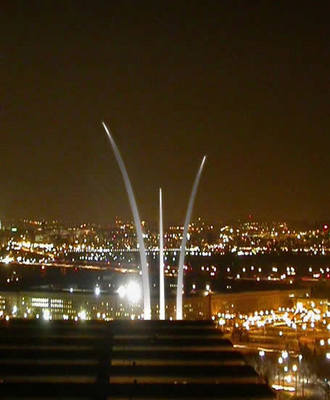
Air Force Memorial Dedication

 This is a great day for the United States Air Force--it is dedication day for the Air Force Memorial in Washington, DC. As a former Air Force enlistee, it brings a great feeling of pride to me. Granted, my personal trials caused some problems for me, but if I could enlist and go through six years all over again, I would. Having been a member of the US Air Force means very much to me.
The Memorial consists of an eight-foot high sculpture, depicting a four figure "Honor Guard," and a 279 foot high triple spire, depicting the famed "Bomb Burst" maneuver of the USAF Thunderbirds Aerial Demonstration Team. The three spires each represent the three aspects of the Air Force creed, "Service, Integrity, and Excellence."
It is a beautiful Memorial, for those who served and gave their lives in conflicts around the world.

Friday, October 13, 2006
Political Finger Pointing Gets Out of Hand
North Korea--the Democrats blame the Republicans, and the Republicans blame the Democrats. NK is trying nuclear blackmail to get what cannot be given them. And it may not have been a nuclear test after all. Finger pointing gets us nowhere.
This video is from the movie South Park: Longer, Harder, Uncut, and is all about finger pointing.
This video is from the movie South Park: Longer, Harder, Uncut, and is all about finger pointing.
Subscribe to:
Posts (Atom)